
Financial Advisors for high-net-worth Individuals are quite important for keeping wealth safe after it comes in. If you choose the wrong advisor, your assets could slowly lose value due to taxes, tactics that don’t work, or risks that aren’t controlled. This article shows high-net-worth people how to find the correct financial advisor by figuring out their goals, checking their credentials, and looking at their investment philosophy. It explains what matters most when choosing Financial Advisors for high-net-worth individuals and how financial services companies like TQM Wealth Partners can help make complicated financial lives clearer and give people confidence in the long-term goals.
People need to be wise about how they spend their money if they want to keep it safe and make it grow with as few risks as possible. Good planning keeps your money safe, saves you from taxes, and preserves your inheritance.
How High Net Worth People Can Find the Right Financial Advisor?
The email came in after midnight.
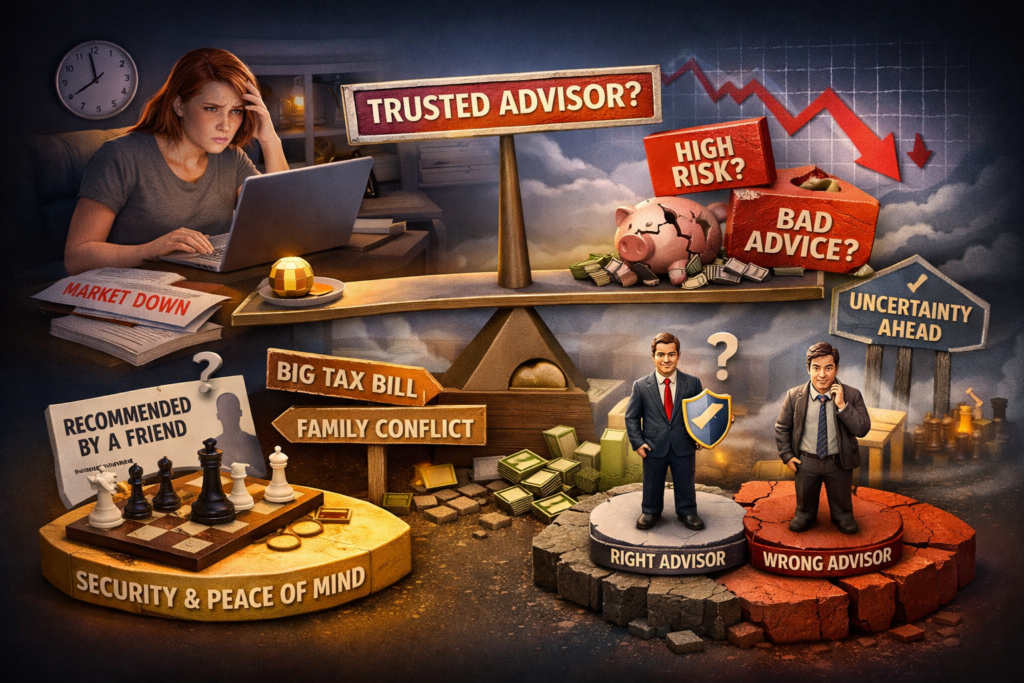
Abby looked at the screen and read the same line again and over. Her advisor’s explanation appeared imprecise and hasty because her investment portfolio had declined substantially during the market slump. For years, she had trusted him. After selling part of her family’s firm, he helped her invest. But now that millions were on the line, she discovered something that made her uneasy. She didn’t really comprehend his plan, what he wanted, or if his financial advice really fits with her aspirations in life.
Abby isn’t the only one.
Many wealthy (HNW) people choose a financial advisor quickly, frequently because someone else recommended them or because it was easy. The important questions come up later, usually when you’re under a lot of stress. A change in the financial market. A big tax bill. A fight in the family. At that point, people start to think that the advisor they picked might not be the best fit for the intricacy of their financial situation.
Not all financial consultants for wealthy people are the same. The appropriate financial advisor can help you keep your money safe, make decisions easier, and stay calm when things are uncertain. The wrong one can cause misunderstanding, unnecessary risk, and long-term damage that is hard to fix.
Why is it more important than ever to find the right HNW financial advisor?
The Capgemini World Wealth Report 2024 says that the number of high-net-worth people around the world is still growing, along with the complexity of their financial needs. The same survey says that wealthy people now care more about trust, openness, and all-around counsel than about how well their investments perform.
This change makes sense. The stakes get higher as wealth accumulates. Choices about taxes, estate planning, investments, and family governance become very linked. A limited or product-focused strategy doesn’t work anymore.
It’s not about choosing a financial counselor who guarantees the best results. It’s about finding someone who knows everything about your finances and can assist you in making smart decisions about them.
“Start by being clear about your financial goals.”
It’s important to know what you want your money to do before you start looking at HNW advisors. A lot of wealthy people have trouble here because they tend to think about things after they succeed.
Some people crave stability after years of taking risks. Some people desire growth to keep going. Many people want both of these things, as well as peace of mind and a clear strategy for the future.
This clarity serves as the standard by which all HNW advisors should be judged. Without it, interactions stay on the surface and are more about performance than wealth purpose.
When people first meet with TQM Wealth Partners, they want to talk a lot about setting goals in ways that are not simply about money. This makes sure that techniques lead to genuine results instead of just abstract goals.
Experience and Credentials Are Not Up for Discussion
Not all financial advisors are able to help people with a lot of money. To handle complexity, you need technical skills, good judgment, and experience.
Credentials don’t always mean excellence, but they do show that someone is committed to professional standards. The CFP Board and CFA Institute say that titles like Certified Financial Planner and Chartered Financial Analyst need a lot of study, high ethical standards, and continual finance training.
Experience is equally important. Financial advisors who work with high-net-worth clients regularly are more likely to know about advanced tax planning, concentrated asset risk, and issues that affect many generations.
A good HNW advisor should be able to break down complicated concepts into simple terms and show you how their experience may help you in your own situation.
A lot may be learned from how advisors get paid.
Whether you mean to or not, the way you pay people affects the advice they give. One of the most crucial things to do when figuring out if an HNW advisor is right for you is to find out how they get paid.
There are two main models:
· Fee-only HNW consultants that charge a clear fee, usually based on how much money they handle or a fixed price for financial planning
· Advisors who make money by selling financial products on a commission basis
High-net-worth people frequently choose fee-only models because they cut down on conflicts of interest. The U.S. Securities and Exchange Commission says that being open about fees and fiduciary duty is an important part of developing trust between advisors and clients.
TQM Wealth Partners focuses on alignment, which means that financial advice is based on what the customer wants, not on what the company wants to sell.
“Your investment philosophy should match your life.”
More than any one piece of financial advice, an advisor’s investment philosophy is important. This way of thinking affects how portfolios are put together, how risk is handled, and how choices are made when things are unstable.
The 2024 Guide to the Markets from J.P. Morgan Asset Management says that long-term investors have historically gotten better results with diversified portfolios that are rebalanced regularly than with reactive or focused strategies.
A good advisor should be able to describe how they think about risk, diversification, and tax efficiency in a way that is easy to understand. More importantly, they should pay close attention to how you feel about risk, not just how it affects your money.
Here, alignment is quite important. If an advisor’s style makes you feel stressed or confused all the time, it’s unlikely to lead to a long-lasting partnership.
Reputation and Compliance Guard More Than Cash
To build trust, you need to be open and honest. Checking out a financial advisor’s past is not about being suspicious; it’s about being careful.
People can check the registration status, disciplinary history, and business practices of investment advisers and brokers on public databases like the SEC Investment Adviser Public Disclosure website and FINRA BrokerCheck. These tools are there to protect investors, so don’t hesitate to use them.
Consistency is another sign of reputation. Advisors who have long-term connections with clients and work well with other experts are frequently more reliable.
People with a lot of money can’t afford to skip this phase. It costs a lot more to ignore red signals than it does to check someone’s credentials and history.
The relationship with the advisor is ongoing, not just a one-time thing.
One thing that people often forget when picking a financial advisor is how the relationship changes over time.
Planning for wealth is not a set thing. Things change in life, the marketplace, and the law. The Federal Reserve’s Survey of Consumer Finances says that families with complicated financial situations benefit a lot from regular evaluations and coordinated planning.
An excellent advisor doesn’t just go away after onboarding. They stay involved, question their assumptions, and revise their plans as needed.
TQM Wealth Partners focuses on developing long-term relationships instead of making plans that only last a short time. This consistency gives clients the confidence to handle changes instead of feeling rushed.
Technology is helpful, but judgment is more important.
Digital tools have made it easier to access data, reports, and portfolio tracking. These tools are useful, but they can’t replace good guidance.
People with a lot of money often have to make choices that are just as emotional as they are economical. Getting rid of a business. Helping grown children. Making plans for the future. These times need background, experience, and a point of view.
An advisor’s job is to help customers make decisions that they can live with, not just ones that look good on paper.
Our Last Thoughts
Choosing a financial advisor for people with a lot of money is one of the most significant things you can do once you have made a lot of money. The proper counsel gives you clarity, alignment, and confidence. The wrong one can slowly destroy everything you’ve worked for.
You may build a good basis for a trustworthy connection by knowing your goals, checking qualifications and experience, looking at pay structures, and making sure everything is in order.
It’s not simply about getting more money. It’s about being a good steward. With the appropriate advisor and a caring, human approach like the one used at TQM Wealth Partners, money can be a source of stability, meaning, and long-term security instead of worrying.
“Not aiming for perfection. It is a collaboration.”