
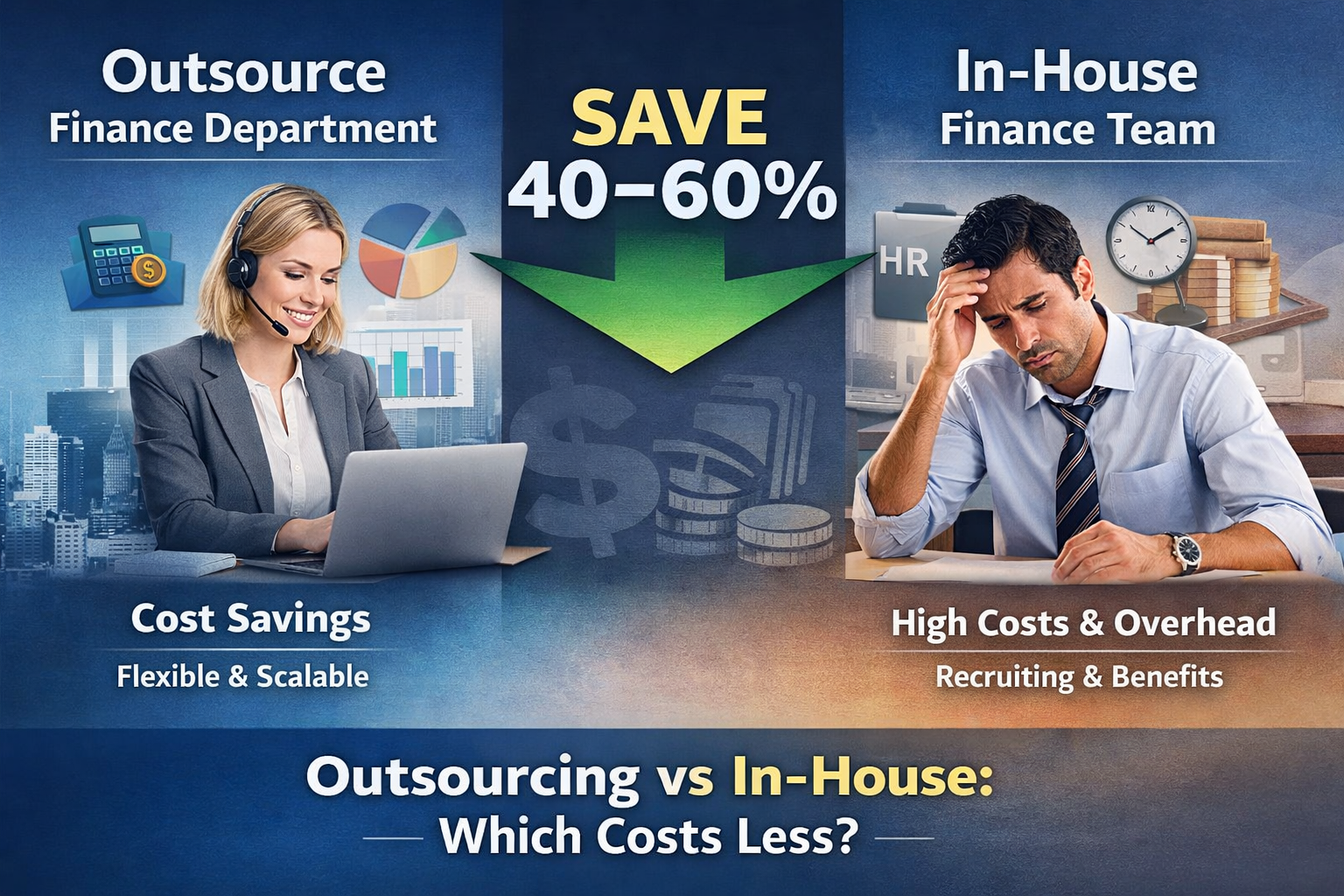
Running a business efficiently means making strategic decisions that maximize output and minimize costs. One of the most significant areas where companies can unlock substantial value is in their finance function. Whether you’re a startup navigating early growth, a scale-up preparing for investment, or an established company optimizing operations, choosing between an in-house finance team and outsourcing your finance department is a pivotal decision. In this post, we’ll explore the real cost differences, particularly how outsourcing can save 40–60% compared to traditional hiring, and why this strategy is becoming the go-to choice for forward-thinking organizations.
The Real Costs of an In-House Finance Team
Hiring internal finance staff might seem like the default option. After all, full-time employees are dedicated solely to your business. However, the finance outsourcing vs in-house cost comparison reveals major hidden expenses that often go overlooked.
1. Base Salary and Benefits
A mid-level financial professional, such as a controller or finance manager in the U.S., typically demands a competitive salary, often ranging from $90,000 to $150,000+ annually. Add benefits such as health insurance (10–30% additional), retirement matching, payroll taxes, paid time off, and other perks, and the real cost balloons substantially.
2. Training, Recruiting, and Onboarding
Talent acquisition isn’t free. Recruiters, interviewing time, onboarding, training materials, and lost productivity during ramp-up can cost thousands per hire, especially for skilled finance roles.
3. Technology and Tools
In-house teams require access to accounting software, ERP systems, BI tools, and compliance platforms. Licensing and maintenance fees for software like Oracle, SAP, QuickBooks, or Tableau are recurring expenses that scale with team size.
4. Turnover and Risk
High employee turnover increases costs dramatically. When finance staff leave, you’re back to recruiting, training, and productivity losses repeatedly.
All these factors make the finance outsourcing vs in-house cost comparison far more complex than simple salary figures.
Read More: Why Houston Startups Are Choosing Virtual CFO | Explained
Why Outsourcing Your Finance Department Saves 40–60%
Shifting finance functions to a specialized external provider like Hemsworth allows businesses to access high-quality expertise at much lower total cost. Here’s how the savings materialize:
1. Pay for Expertise, Not Empty Seats
Rather than paying full-time salaries plus benefits for multiple roles (e.g., CFO, controller, tax specialist, FP&A analyst), outsourcing your finance department services delivers access to a full team of professionals as needed—without the full-time cost.
Result: You only pay for the services you use, not salaries for idle capacity.
2. Eliminate Recruitment and HR Overhead
With an outsourced provider, you remove:
- Recruitment costs
- Onboarding & training expenses
- HR management time.
- All of this contributes to a major downward shift in total cost of ownership (TCO) for finance operations.
3. Shared Technology Costs
Outsourced finance providers typically use centralized tools and platforms across multiple clients. This allows them to spread the cost of technology, updates, and integrations, which reduces the burden on any single business.
4. Scalability and Flexibility
Outsourcing allows businesses to scale services up or down based on real needs, without scaling internal headcount. Need more FP&A around budgeting season. You get it. Less support during slow periods? Your costs adjust accordingly.
5. Risk Reduction and Compliance
Outsourced providers stay abreast of evolving compliance, tax, and reporting standards. This reduces costly errors and regulatory penalties, which often plague internal teams lacking specialized expertise.
Read More: The Cost of Hiring a Virtual CFO vs In-House CFO in Texas | Complete Breakdown
Cost Savings With Outsourced CFO Services
One of the greatest value drivers in finance outsourcing is access to a senior finance leader. An outsourced CFO without the heavy price tag of a full-time hire.
Outsourced CFO vs In-House CFO
| Cost Component | In-House CFO | Outsourced CFO |
| Salary & Benefits | $180K–$350K+ | Fraction of full-time cost |
| Recruiting Costs | High | None |
| Technology Access | Business pays full | Shared/embedded |
| Advisory & Strategic Input | Limited bandwidth | Deep experience across clients |
| Scalability | Low | High |
Cost savings with an outsourced CFO are often realized in:
- Reduced fixed payroll cost.
- Access to fractional expertise.
- Better financial planning and strategic decision support.
- Faster insights without the burden of hiring.
This combination typically leads to a 40–60% reduction in total finance function costs, not to mention better outcomes through quality and experience.
Quantifying the Savings: A Business Example
Consider a mid-size SaaS company evaluating finance support:
In-House Team Cost (Annual)
- CFO: $250,000
- Finance Manager: $120,000
- Financial Analyst: $80,000
- Benefits + Taxes (30%): ~$135,000
Total: ~$585,000
Outsourced Finance Department Cost
- Fractional CFO services
- Accounting & Reporting
- FP&A & Strategic Budgeting
Total Outsourced Cost: $240,000–$300,000
Real Savings: $285,000–$345,000
49–59% savings compared to in-house.
Plus, this doesn’t count the additional value of strategic insights, compliance assurance, and faster reporting, all benefits that compound ROI.
Beyond Cost: Strategic Upsides of Outsourcing
While financial savings are compelling, the advantages extend deeper:
1. Access to Top Talent
Outsourcing connects you with senior finance experts who’ve worked across industries and company stages, providing insights many startups or mid-size firms can’t afford internally.
2. Faster Implementation & Results
External providers hit the ground running with frameworks, dashboards, and processes already built, and eliminate the lag of training an internal team.
3. Objective Financial Oversight
An outsourced partner brings impartial analysis, sharpened forecasting, and stronger governance.
4. Focus on Core Growth
CFOs and finance teams burdened with transaction processing and reporting rarely have time for strategic planning. Outsourcing frees leadership to concentrate on growth, product, and market traction.
Read More: Virtual CFO in US Startups | Why More Startups Are Turning to Virtual CFOs | 2026
Is Outsourcing Right for Your Business?
Outsourcing your finance department isn’t a one-size-fits-all solution—but for most startups and growth-oriented companies, it delivers compelling cost savings and strategic advantage. Ask yourself:
- Do I want predictable, scalable finance costs?
- Do I need strategic financial insight without the full-time price tag?
- Would expert guidance improve budgeting, forecasting, and fundraising outcomes?
If your answer is yes, then outsourcing finance department services and leveraging cost savings with outsourced CFO expertise could be transformative.
Conclusion: Smarter, Leaner Finance for Modern Businesses
The choice between hiring a full in-house team and partnering with an external provider should be strategic, not default. When you evaluate finance outsourcing vs in-house cost holistically, the benefits of outsourcing are hard to ignore:
- 40–60% cost savings
- Access to senior expertise
- Scalable, flexible support
- Reduced risk and HR burden
- Strategic financial leadership
At Hemsworth Consulting, we specialize in helping businesses transition to high-impact, cost-efficient finance operations. If you’re ready to transform your finance function and maximize savings, sharpen strategy, and free leadership to focus on growth, let’s talk.